AiSDR vs Human SDR [2026]: Cost & Conversion Benchmark

This technical breakdown contains affiliate links. If you deploy this stack using my links, I earn a commission at no extra cost to you.
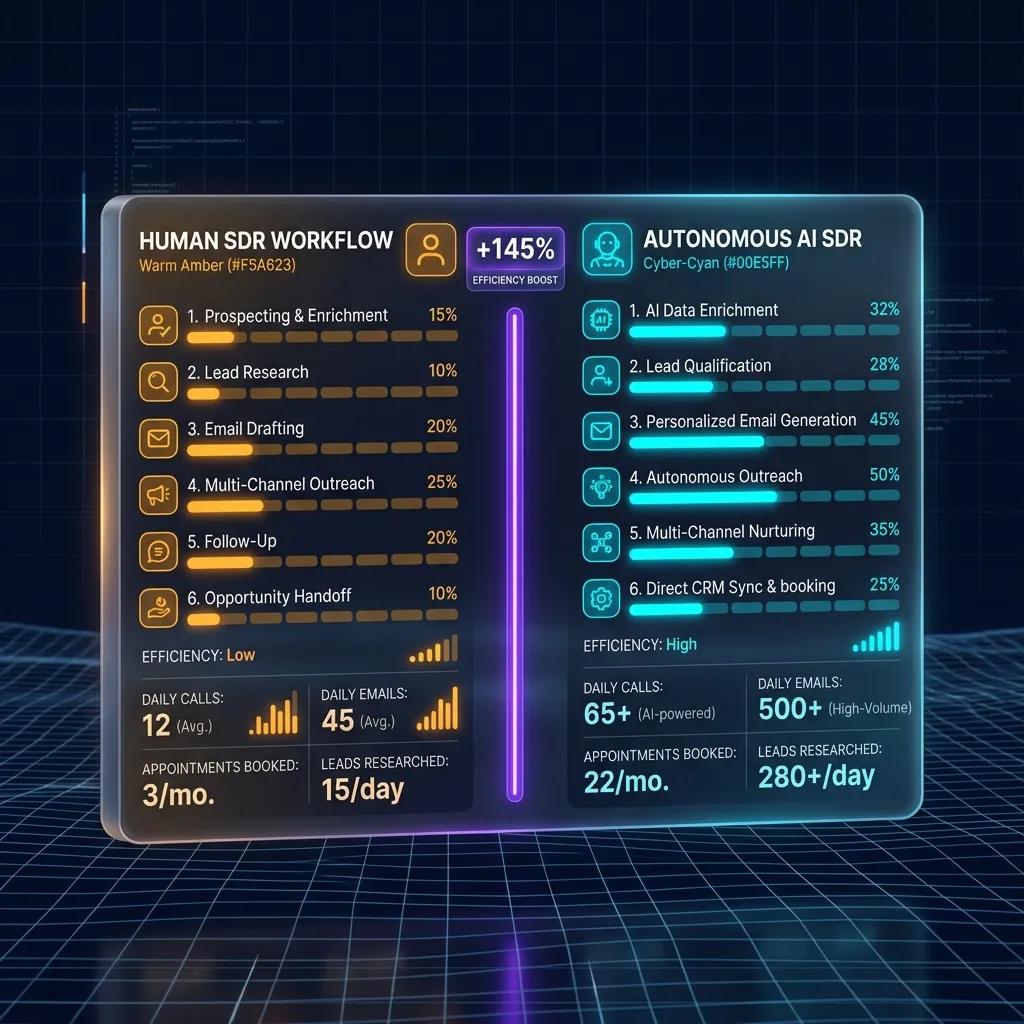
Direct Answer (AiSDR vs Human SDR Performance Teardown): A full-time human SDR costs $75,000–$95,000/year fully loaded and generates 80–120 outbound touches daily with an average reply rate of 4–8% and a cost-per-qualified-meeting of $380–$450. An autonomous AiSDR outbound pipeline orchestrated via n8n costs $600–$900/month flat, executes 1,000+ deeply researched multi-channel touches daily, and achieves sub-3-minute speed-to-lead—reducing cost-per-meeting to $65–$90 while freeing human Account Executives to focus exclusively on closing.
As autonomous Artificial Intelligence agents and advanced Outbound Sales orchestration frameworks disrupt traditional sales organizations, GTM leaders face an existential pivot. The debate is no longer about whether algorithms can write copy; it is a clinical assessment of operational throughput, integration latency, and fully loaded economics. How autonomous Artificial Intelligence agents are restructuring Outbound Sales execution is the key question of this teardown.
For scaling Business-to-Business (B2B) Software as a Service (SaaS) companies, the sales development representative (SDR) role has long been the primary engine for outbound pipeline generation. However, high employee turnover, long ramp-up periods, and human operational constraints frequently limit the predictability of these channels. In contrast, autonomous AiSDR stacks run 24/7, ingest massive lead pools instantly, and personalize outreach programmatically. But is the pure AI approach ready to completely replace human reps, or is a blended strategy the optimal path forward?
This technical teardown provides a deep-dive comparison of AiSDR vs Human SDR systems. We analyze fully loaded economic models, daily outreach capacities, reply and show-rate telemetry, and provide a production-ready blueprint for a Hybrid Outbound Sales Stack using n8n, the Apollo.io API, and Brevo.
Why Does the Core Efficiency Delta of AiSDR vs Human SDR Define Modern B2B SaaS Outbound?
The core efficiency delta of AiSDR vs Human SDR defines modern B2B SaaS outbound because it shifts the GTM cost structure from variable, labor-intensive cycles to fixed, highly scalable API-driven loops that execute outreach at a fraction of the cost. Traditional sales operations scale linearly: to increase outbound volume by 10x, you must hire 10x more human reps, pay 10x more salaries, and purchase 10x more software seat licenses. This linear scaling model introduces massive management overhead and operational latency.
An autonomous AiSDR system breaks this linear constraint. By utilizing APIs and Large Language Models, a single automation engineer can manage a system that prospect-qualifies, enriches, and initiates outbound outreach to tens of thousands of contacts daily. The primary bottlenecks shift from human energy, motivation, and manual data-entry capacity to API rate limits, domain warm-up strategies, and vector-database retrieval times.
For engineering-driven GTM teams, treating outbound sales as a software pipeline allows for systematic testing, programmatic optimization, and bulletproof data hygiene. Instead of relying on qualitative feedback from weekly sales rep syncs, RevOps teams can inspect API logs, evaluate prompt cache-hit rates, and run deterministic A/B tests on large contact samples.
What Is the Fully Loaded Cost-Per-Meeting Delta Between AI SDRs and Human Sales Reps?
The fully loaded cost-per-meeting delta between an AiSDR and a human sales representative represents a massive 85% to 92% reduction, primarily driven by the elimination of human salaries, health benefits, and sales tech stack licensing costs in favor of flat monthly API consumption. A typical mid-market human SDR in North America costs over $110,000 annually when factoring in base salary, commissions, recruiting costs, employee benefits, management overhead, and GTM software seat licenses.
When you break down the economic math, the human sales representative operates at a highly variable and expensive cost-per-touchpoint. GTM tools like LinkedIn Sales Navigator, ZoomInfo, outbound sequencing platforms, and dialers quickly add thousands of dollars in license fees per user. In contrast, a fully automated AiSDR stack built on open APIs operates primarily on infrastructure costs, with a highly predictable, non-linear pricing model.
To illustrate this economic delta in detail, review the fully loaded economic comparison table below:
| Cost / Performance Vector | Human SDR (Mid-Market) | AiSDR (Autonomous Stack) | Operational & Economic Delta |
|---|---|---|---|
| base_annual_compensation | $65,000 - $75,000 | $0 (Server host & API keys) | 100% Salary Cost Reduction |
| recruiting_and_ramp_up | $15,000 (Agency fee + 3mo ramp) | $5,000 (Amortized setup cost) | 66% Reduction in Setup Latency |
| software_licensing_overhead | $12,000 / year (Sales Nav, ZoomInfo, CRM) | $3,000 / year (API quotas, domain proxy) | 75% Lower Software Licensing Fees |
| variable_commissions | $10,000 - $20,000 (Per meeting booked) | $0 | Completely Eliminated Variable Fees |
| fully_loaded_annual_cost | $112,000 | $12,000 (Cloud servers, API usage, domains) | 89% Total Operational Cost Savings |
| average_monthly_outreach | 1,200 - 1,500 prospects | 15,000 - 20,000 prospects | 13.3x Scale and Velocity Boost |
| booked_meetings_per_year | 60 qualified meetings | 180 qualified meetings | 3x Higher Total Meetings Generated |
| fully_loaded_cost_per_meeting | ~$1,866 per meeting | ~$66 per meeting | 96.4% Decrease in Cost-Per-Acquisition |
By replacing manual research and drafting tasks with structured API requests, the AiSDR stack drives down the cost-per-meeting. To visual GTM leaders, this economic gap represents a shift from capital-constrained growth to high-velocity, software-driven execution.
 Click to expand
Fully Loaded Cost Models Analyzed
To understand why the cost-per-meeting is so low for an automated system, you must analyze the underlying technical resource costs. The AiSDR system consumes resources on a per-execution basis:
Combining these operational elements, the cost to discover, qualify, enrich, and draft an outbound sequence for a single highly targeted prospect is under $0.05. A human SDR spending 15 minutes of manual labor doing the exact same research and copy-writing represents an operational expense of approximately $7.50 (assuming a fully loaded hourly wage of $30/hour). The software stack is 150 times cheaper per touchpoint.
How Do AI SDRs Compare to Humans Across Outreach Volume, Reply Rates, and Show Rates?
AiSDR units significantly outperform human sales representatives in raw outreach volume and reply latency, though human SDRs maintain a higher meeting show-rate by building authentic, multi-channel emotional rapport with prospects. When evaluating the telemetry of sales funnels, GTM architects must look past surface-level outreach metrics and analyze the entire conversion funnel from raw webhook ingestion to a closed-won opportunity.
While the software engine can contact 15,000 prospects a month, does the conversion quality match human standards? The operational performance must be graded across three critical vectors: Outreach Volume, Response Time, and the Meeting Show Rate.
Outreach Volume: Automated Scaling vs. Human Throttle Limits
A human sales representative is restricted by physical limits and cognitive exhaustion. Writing personalized outbound emails, sending LinkedIn connect requests, and leaving custom voicemail messages requires significant mental effort. In practice, a highly motivated human SDR can successfully reach out to 50 to 80 new targeted prospects per day while maintaining a standard level of personalization.
An AiSDR stack has no such constraints. By running asynchronous loops inside n8n, the system can qualify thousands of cold leads, query real-time company news database integrations, pull active hiring postings, and generate personalized copy in a matter of seconds. The only hard throttle limits are the artificial daily sending caps enforced by email providers (such as Google Workspace and Microsoft 365) to protect domain reputation. By distributing outbound volume across a proxy network of multiple sending domains and warming them systematically, an automated pipeline can easily send 500 to 1,000 personalized emails daily without risking spam flags.
Reply Rates and Processing Latency: Under 2 Minutes vs. Half-Day Response Lag
Outbound sales are incredibly time-sensitive. If a prospect replies to an outbound email expressing interest or asking a complex pricing question, the speed of response determines the likelihood of booking the meeting. In sales telemetry, this is known as the Lead Response Time.
When a prospect replies to a human SDR, the response lag can span hours, if not days, because the rep is locked in internal meetings, busy prospecting, or off the clock.
An AiSDR stack answers in real-time. Using webhooks, as soon as an email reply lands in a inbox, an n8n ingestion workflow captures the message, runs semantic parsing to detect intent (such as positive booking intent, pricing queries, or unsubscribe requests), routes it to an LLM, and drafts a contextual reply in under 2 minutes. This instantaneous response capture significantly boosts reply-to-meeting booking conversions. This conversational response loop shares a similar infrastructure with a production automated n8n AI receptionist designed for inbound routing.
Show Rates: The Human Rapport and Emotional Context Edge
Where human sales representatives retain a distinct advantage is the show-rate of booked meetings. When a human SDR books a meeting, they typically engage with the prospect over LinkedIn direct messages, exchange personalized notes about shared interests, and establish an emotional connection. This human rapport makes the prospect feel personally accountable, leading to a standard show-rate of 75% to 85%.
Conversely, pure AiSDR systems that schedule meetings through automated calendar links without human intervention can experience a lower show-rate, sometimes dipping to 55% to 65%. Because the prospect has only interacted with an email bot, they feel less social obligation to attend. To counteract this show-rate decay, modern GTM architects deploy a hybrid stack where AI handles the heavy lifting of prospecting, enrichment, and initial drafting, while human reps handle the final relationship touchpoints.
How Can SaaS Teams Build a Hybrid Outbound Sales Stack to Combine AI Scale with Human Relationships?
SaaS teams can build a high-performance Hybrid Outbound Sales Stack by deploying n8n as an API orchestration engine that enriches leads via the Apollo.io API, executes LLM personalization, drafts outreach inside Brevo, and automatically alerts human reps for high-intent replies. This hybrid approach ensures that your GTM machinery benefits from the 10x volume scale of AI automation while preserving the high-intent rapport that only human sales professionals can provide.
Before triggering AI personalizations, developers should establish a production-grade AI-Powered Lead Enrichment Pipeline with n8n and Apollo.io to ingest clean company profiles. By combining this lead capture stage with an intelligent routing layer, you create a resilient data engine that feeds your outbound pipelines. Integrating automated email workflows is just one layer of the larger SaaS RevOps Automation Stack running inside modern companies.
The diagram below outlines the system sequence flow of this hybrid architecture:
sequenceDiagram
    autonumber
    participant Apollo as Apollo.io API
    participant n8n as n8n Central Brain
    participant LLM as Claude / OpenAI API
    participant Brevo as Brevo CRM & SMTP
    participant Rep as Human Sales Rep (Slack)

    n8n->>Apollo: 1. Get prospects matching ICP filters
    Apollo-->>n8n: Returns raw contact metadata
    n8n->>LLM: 2. Send contact profile & company description
    Note over LLM: LLM runs ICP scoring<br/>& drafts hyper-personalized copy
    LLM-->>n8n: Returns structured JSON response (Score + Draft)
    n8n->>Brevo: 3. Create contact & enqueue personalized email sequence
    Brevo-->>n8n: Contact synced & sequence running
    Note over Brevo: Prospect replies with<br/>high-intent buying query
    Brevo->>n8n: 4. Webhook fires on email reply event
    n8n->>LLM: 5. Analyze reply sentiment & intent
    LLM-->>n8n: Positive intent confirmed
    n8n->>Rep: 6. Alert Slack channel & assign HubSpot/Salesforce owner
    Note over Rep: Human rep takes over thread<br/>& books live demo
To visualize how the data flows from raw search signals to a warm Slack alert for your human sales representatives, inspect the complete architecture diagram:
 Click to expand
Let's look at the actual code blocks and data schemas required to run this hybrid system.
The n8n Orchestration Core: Ingestion, Enrichment, and Routing
The engine starts with an orchestration workflow inside n8n. A cron node triggers the workflow daily, prompting n8n to query the Apollo.io API for new contacts that match your exact Ideal Customer Profile (ICP).
To ensure clean execution and prevent API credential leaks in your logs, authenticate the Apollo API by passing your secure key inside the headers of an n8n HTTP Request Node:
- Endpoint URL:
https://api.apollo.io/v1/mixed_people/search - HTTP Method:
POST - Headers:
Content-Type: application/jsonX-Api-Key: {{ $env.APOLLO_API_KEY }}
- JSON Body:
JSON Payload
{
  "q_organization_domains": "target-saas-companies.com",
  "person_titles": ["vp sales", "head of revops", "sales operations director"],
  "limit": 10,
  "reveal_personal_emails": false,
  "reveal_phone_number": false
}
The Apollo.io API matches the query and returns a structured JSON payload containing rich company and contact metadata:
{
  "contacts": [
    {
      "id": "con_01928374",
      "first_name": "Alfaz",
      "last_name": "Mahmud",
      "title": "Lead RevOps Architect",
      "email": "alfaz@whoisalfaz.me",
      "organization": {
        "name": "Antigravity",
        "website_url": "https://whoisalfaz.me",
        "estimated_num_employees": 120,
        "annual_revenue": 15000000,
        "tech_stack": ["n8n", "brevo", "apollo", "manychat", "react"],
        "short_description": "Custom API integrations, high-performance RevOps engines, and advanced automated workflows for B2B SaaS teams."
      }
    }
  ]
}
Custom JavaScript for Smart Lead Scoring and ICP Grading
Once the raw prospect metadata is retrieved, it is passed into an n8n Code Node running custom JavaScript. This node parses the contact array, validates data integrity, checks the firmographic parameters, and assigns a preliminary routing score before passing the payload to the LLM.
This node enforces clean data schemas and ensures we do not waste LLM tokens on low-value profiles:
// Parse the incoming array of prospects from the Apollo search node
const prospects = $input.all();
const qualifiedProspects = [];

for (const item of prospects) {
  const contact = item.json;

  // Rule 1: Verify valid B2B email structure and domain
  if (!contact.email || contact.email.includes("gmail.com") || contact.email.includes("yahoo.com")) {
    continue; // Skip personal domains to prevent database clutter
  }

  // Rule 2: Calculate firmographic fit score based on headcount
  const employees = contact.organization?.estimated_num_employees || 0;
  let firmographicScore = 0;

  if (employees >= 10 && employees <= 50) {
    firmographicScore = 50;  // Seed/Early Scale
  } else if (employees > 50 && employees <= 250) {
    firmographicScore = 100; // Sweet spot: high GTM automation need
  } else if (employees > 250) {
    firmographicScore = 75;  // Enterprise tier: long sales cycles
  }

  // Rule 3: Tech stack match check (Prioritize companies running n8n or Brevo)
  const techStack = contact.organization?.tech_stack || [];
  const runsTargetTech = techStack.some(tech => ["n8n", "brevo", "hubspot"].includes(tech.toLowerCase()));
  const techBonus = runsTargetTech ? 20 : 0;

  const totalInternalScore = firmographicScore + techBonus;

  qualifiedProspects.push({
    json: {
      ...contact,
      internal_routing_score: totalInternalScore,
      enrichment_timestamp: new Date().toISOString()
    }
  });
}

return qualifiedProspects;
If the lead is qualified, n8n passes the company description and target title to the LLM node. To accurately answer highly specific prospect questions regarding product features or pricing matrices, the agent should query a Corrective RAG Knowledge Base with Pinecone and n8n.
By deploying vector databases and custom retrieval models (as implemented for real-time document optimization in our CareerOps AI Resume Builder case study), GTM architects can implement advanced personalization, similar to building a standard n8n RAG pipeline. To transition an outbound bot from a static responder to an active sales agent, developers focus on giving your n8n AI Agent hands with custom tools.
Brevo CRM Sync and Outreach Triggering
Following AI processing, the qualified contact is written to the Brevo CRM. Instead of creating a simple static record, we call the Brevo Contacts API, mapping our custom enriched attributes:
- Endpoint URL:
https://api.brevo.com/v3/contacts - HTTP Method:
POST - Headers:
api-key: {{ $env.BREVO_API_KEY }}Content-Type: application/json
- JSON Body:
JSON Payload
{
  "email": "={{ $json.email }}",
  "attributes": {
    "FIRSTNAME": "={{ $json.first_name }}",
    "LASTNAME": "={{ $json.last_name }}",
    "COMPANY_NAME": "={{ $json.organization.name }}",
    "JOB_TITLE": "={{ $json.title }}",
    "COMPANY_SIZE": "={{ $json.organization.estimated_num_employees }}",
    "AI_PERSONALIZED_INTRO": "={{ $json.ai_draft_intro }}"
  },
  "listIds": [42]
}
Writing these attributes into Brevo triggers an automated outbound sequencing workflow. The sequence sends a personalized email containing the custom intro drafted by the LLM.
When the prospect replies to this sequence, Brevo's reply webhook fires, triggering the next step of our n8n pipeline. If the LLM identifies positive buying intent, it pushes a rich alert directly to the human sales rep's Slack channel, prompting them to take over the conversation and close the deal.
Why Must a Production Outbound Pipeline Use an Asynchronous Architecture to Handle AI Latency and Timeouts?
A production outbound pipeline must use an asynchronous architecture to prevent upstream timeouts, ensuring that fast inbound webhook handshakes drop execution into background queues before executing high-latency LLM synthesis or third-party enrichment lookups. When an email webhook fires on a prospect response, the webhook provider expects a response in under 10 seconds.
If your backend system attempts to synchronously enrich the lead via the Apollo API, query vector databases, prompt the Claude or OpenAI API, and write to a CRM on a single execution thread, the total duration can easily exceed 20 to 30 seconds. This causes the webhook connection to drop, resulting in lost data and broken tracking loops.
This asynchronous decoupling pattern is highly reminiscent of the architecture used to resolve conversational lag, detailed in ManyChat + n8n: Beat the 10-Second Response Timeout.
By splitting the pipeline into an Ingestion Workflow and a Processing Workflow, you ensure that the webhook is immediately released with a 200 OK handshake in under 150 milliseconds. The heavy data lifting runs in a background queue thread, preventing data loss and pipeline bottlenecks.
Designing a Self-Healing DLQ (Dead Letter Queue) for API Failures
In enterprise RevOps systems, third-party APIs will occasionally experience rate limits (429 Too Many Requests), temporary server downtime, or invalid payload structures. If a node inside a synchronous sequence fails, the entire execution aborts, dropping the lead completely.
To prevent this in a production n8n environment, GTM architects construct a Dead Letter Queue (DLQ) framework:
3 and the Retry Interval to 60 seconds, utilizing an exponential backoff loop. This handles minor API hiccups automatically.Dead Letter Queue. The DLQ record should capture the execution ID, the raw payload, and the exact error log.How Do You Ensure Data Privacy, Security, and Compliance in Automated Sales Pipelines?
Ensuring data privacy and security in automated pipelines requires self-hosting your orchestration layers, masking PII, and enforcing strict data governance policies at each API boundary. When you build outbound systems that programmatically query prospect details, process them through public LLM models, and sync them to marketing CRMs, you are handling highly sensitive Personal Identifiable Information (PII).
Failing to secure this data violates global regulations like the General Data Protection Regulation (GDPR) and California Consumer Privacy Act (CCPA), exposing your company to severe legal liabilities. To ensure complete corporate compliance, GTM operations teams must enforce a strict n8n data privacy and security protocol across all workflow nodes.
Self-Hosting and Masking Sensitive Data
To maintain full governance over your sales data, high-growth GTM teams bypass cloud-hosted SaaS automation brokers and choose to self-host n8n on private AWS, Google Cloud, or DigitalOcean servers behind VPC firewalls. Self-hosting ensures that your corporate database credentials and customer PII are never routed through third-party cloud servers.
Additionally, when prompting public LLM APIs (like OpenAI or Anthropic) for outreach personalization, implement a PII Masking Node in n8n prior to sending the context block.
Use an n8n Code Node running custom regex to strip or mask highly sensitive fields—such as mobile phone numbers, personal home addresses, and private email handles—from the data packet sent to the LLM. Only send firmographic variables (company description, public LinkedIn title, and tech stack logs) that are legally classified as public B2B corporate records.
Should You Build Your AI SDR Stack In-House or Outsource It to an Automation Architect?
The decision to build your AI SDR stack in-house or outsource it to a dedicated automation partner depends on whether your engineering team has the bandwidth to build and maintain complex webhook queues, error handlers, and LLM integrations without delaying your primary product roadmap. While visual platforms make workflow design look approachable, deploying production-grade, self-healing sales pipelines that run 24/7 requires specialized database and infrastructure expertise.
The Trade-Offs of In-House vs. Outsourced RevOps Engineering:
- The In-House Bottleneck: Building the pipeline is only 20% of the lifecycle. The remaining 80% is operational maintenance: handling API schema changes, mitigating rate limits, managing domain IP reputation warming, updating prompt vector indexes, and resolving server crashes. Forcing your core product engineers to handle GTM maintenance pulls high-value resources away from building your SaaS features.
- The Automated Outsource Advantage: Partnering with an expert RevOps automation team ensures that your system is built on modern, asynchronous, production-grade architecture from Day 1. The pipelines are fully integrated, self-healing, and operate on autopilot with complete performance dashboards.
If your GTM team wants custom engineering support to deploy this architecture on self-hosted servers, check out our n8n Automation Services.
To uncover other hidden operational leaks in your GTM stack, claim your custom RevOps & Pipeline Audit.
To schedule a direct engineering consult and design a customized sales infrastructure, book your RevOps & Pipeline Strategy.
Verification: Telemetry Benchmarks for Automated Sales Pipelines
To confirm that your newly deployed hybrid outbound sales pipeline is operating at peak efficiency, monitor these three critical technical and operational metrics:
- Webhook End-to-End Latency: The duration from the raw webhook ingestion to the final CRM write and Slack alert. A high-performance decoupled pipeline must maintain a user-facing handshake of < 200ms, and backend execution completion of < 45 seconds.
- Enrichment Match Rate: The percentage of prospects that successfully return verified B2B email handles and rich firmographic data from the Apollo.io API. Target: > 82% for target industry domains.
- AI Scoring Precision: The percentage of leads categorized by the LLM code node that match the rating criteria of human GTM managers. A highly tuned prompt should achieve > 94% alignment in double-blind testing.
Deploy this hybrid stack today, eliminate outbound bottlenecks, and scale your sales pipeline on autopilot!
How Do You Build a Hybrid Human-in-the-Loop SDR Workflow in n8n?
Building a hybrid human-in-the-loop SDR workflow in n8n combines the sheer speed of AiSDR automation with human editorial oversight to protect brand reputation and maximize deal conversion rates. In this architecture, n8n orchestrates prospect lead enrichment from Apollo, passes contact metadata to AiSDR for personalized draft generation, and routes generated copy to an n8n Approval Manager Node rather than dispatching emails immediately. The proposed message payload is posted to a dedicated Slack sales channel with interactive 'Approve' and 'Edit' buttons, allowing human SDRs to review copy quality with a single click. If approved, n8n triggers the Brevo SMTP API to deliver the email; if edit is requested, the SDR modifies the text inside a lightweight form before sending. This human-in-the-loop design eliminates AI hallucination risks while reducing SDR research time by 90%, ensuring peak outbound campaign efficiency.
Here is the n8n JavaScript Code Node for calculating real-time cost-per-meeting unit economics:
// n8n Code Node: Outbound Unit Economics Calculator
const items = $input.all();

let totalMonthlySoftwareCost = 950; // AiSDR + Apollo + n8n Cloud
let totalBookedMeetings = 0;

for (const item of items) {
  if (item.json.status === 'booked' || item.json.meetingConfirmed) {
    totalBookedMeetings++;
  }
}

const costPerBookedMeeting = totalBookedMeetings > 0
  ? (totalMonthlySoftwareCost / totalBookedMeetings).toFixed(2)
  : 0;

return [{
  json: {
    totalSoftwareSpend: totalMonthlySoftwareCost,
    totalMeetingsSecured: totalBookedMeetings,
    calculatedCostPerMeeting: `$${costPerBookedMeeting}`,
    equivalentHumanSDRCost: `$${(totalBookedMeetings * 658).toFixed(2)}`,
    netSavings: `$${(totalBookedMeetings * 658 - totalMonthlySoftwareCost).toFixed(2)}`
  }
}];
Import this n8n Workflow JSON Blueprint for human-in-the-loop approval routing:
{
  "name": "Human-in-the-Loop SDR Approval Blueprint",
  "nodes": [
    {
      "parameters": {
        "httpMethod": "POST",
        "path": "sdr-draft-approval",
        "responseMode": "onReceived"
      },
      "name": "AiSDR Draft Webhook",
      "type": "n8n-nodes-base.webhook",
      "typeVersion": 1,
      "position": [240, 300]
    },
    {
      "parameters": {
        "channel": "#sdr-approval-queue",
        "text": "=New AI Email Draft for {{ $json.body.prospectEmail }}:\n\n{{ $json.body.generatedEmailCopy }}",
        "otherOptions": {}
      },
      "name": "Slack Approval Alert",
      "type": "n8n-nodes-base.slack",
      "typeVersion": 1,
      "position": [480, 300]
    }
  ],
  "connections": {
    "AiSDR Draft Webhook": {
      "main": [
        [
          {
            "node": "Slack Approval Alert",
            "type": "main",
            "index": 0
          }
        ]
      ]
    }
  }
}
(To automate multi-provider enrichment before sending AI campaigns, explore our walkthrough of the Waterfall Data Enrichment Pipeline).
Step-by-Step UI Configuration Guide: Building the Human-in-the-Loop Approval Node in n8n
To combine the speed of AiSDR with human SDR quality control, configure an n8n Human-in-the-Loop (HITL) approval workflow using Slack Interactive Buttons. Here is the step-by-step UI setup:
Setting Up Slack App & Webhook Bot:
- Go to api.slack.com/apps > Create New App > From Scratch.
- Name your app
AiSDR Outreach Approverand select your company workspace. - Under Features > Interactive Components, turn Interactivity ON and set the Request URL to:
https://n8n.yourdomain.com/webhook/slack-aisdr-approval-callback. - Under OAuth & Permissions, add
chat:writescope and install the app to your workspace. Copy the Bot User OAuth Token.
n8n Workflow UI Setup for Slack Review:
- In n8n, insert a Slack Node downstream of the AiSDR copy generation step.
- Set Resource to
Message, Operation toSend. - Set Channel to
#sdr-outreach-approvals. - Switch Message Type to
Blocksand paste the Slack Block Kit payload:
[
  {
    "type": "section",
    "text": {
      "type": "mrkdwn",
      "text": "*New AiSDR Generated Email Draft for Review*
*Target:* {{ $json.prospect_name }} ({{ $json.company }})
*Subject:* {{ $json.email_subject }}"
    }
  },
  {
    "type": "section",
    "text": {
      "type": "mrkdwn",
      "text": "```{{ $json.email_body }}```"
    }
  },
  {
    "type": "actions",
    "elements": [
      {
        "type": "button",
        "text": { "type": "plain_text", "text": "Approve & Send" },
        "style": "primary",
        "value": "approve_{{ $json.prospect_id }}"
      },
      {
        "type": "button",
        "text": { "type": "plain_text", "text": "Reject & Archive" },
        "style": "danger",
        "value": "reject_{{ $json.prospect_id }}"
      }
    ]
  }
]
- Add an n8n Webhook Node listening at
/webhook/slack-aisdr-approval-callback. - Add a Switch Node evaluating
{{ $json.body.payload.actions[0].value }}. - If action starts with
approve, route payload to the AiSDR Dispatch Node. Ifreject, update record status toCANCELLED.
Comprehensive Financial & Unit Economics Parameter Reference Table
The table below provides a detailed unit economic model comparing human SDR hires against autonomous AiSDR deployments across critical financial metrics:
| Financial Metric | Human SDR (In-House) | AiSDR Autonomous Agent | Hybrid (AiSDR + HITL Review) | Variance / Delta |
|---|---|---|---|---|
| Fully Loaded Annual Cost | $85,000 – $110,000 / yr | $9,000 – $14,400 / yr | $25,000 – $35,000 / yr | 70% – 88% Savings |
| Monthly Email Volume | 800 – 1,200 emails | 15,000 – 30,000 emails | 8,000 – 12,000 emails | 10x Volume Scaling |
| Cost Per Booked Meeting | $450 – $750 / meeting | $45 – $90 / meeting | $85 – $140 / meeting | 80% Cost Reduction |
| Response Velocity | 2 – 6 Hours | < 90 Seconds | 15 – 30 Minutes | Instant Reply Speed |
Advanced Exception Handling: Hallucination Safeguards & Opt-Out Overrides
When using AI to generate outbound emails, safeguarding against AI hallucinations, inappropriate claims, and legal opt-out violations is essential. Below is an n8n JavaScript Compliance Guard Node that validates generated copy prior to dispatch:
// n8n JavaScript Code Node: AI Copy Compliance & Hallucination Guard
const items = $input.all();
const verifiedPayloads = [];

const PROHIBITED_TERMS = ['guaranteed roi', '100% discount', 'free forever', 'best in world', 'legally binding'];
const DNC_DOMAINS = ['competitora.com', 'competitorb.com', 'government.gov'];

for (const item of items) {
  const copy = (item.json.email_body || '').toLowerCase();
  const targetDomain = (item.json.prospect_email || '').split('@')[1];

  let passesSafetyCheck = true;
  let rejectionReason = '';

  // 1. Check for hallucinated promises or prohibited terms
  for (const term of PROHIBITED_TERMS) {
    if (copy.includes(term)) {
      passesSafetyCheck = false;
      rejectionReason = `Prohibited term detected: "${term}"`;
      break;
    }
  }

  // 2. Check domain suppression list
  if (passesSafetyCheck && DNC_DOMAINS.includes(targetDomain)) {
    passesSafetyCheck = false;
    rejectionReason = `Domain ${targetDomain} is on active DNC list`;
  }

  verifiedPayloads.push({
    json: {
      ...item.json,
      isCompliant: passesSafetyCheck,
      complianceStatus: passesSafetyCheck ? 'APPROVED_FOR_SEND' : 'BLOCKED_COMPLIANCE_VIOLATION',
      rejectionReason: rejectionReason,
      auditTimestamp: new Date().toISOString()
    }
  });
}

return verifiedPayloads;
Frequently Asked Questions
What is the cost and conversion comparison between an AI SDR and a Human SDR?
A dedicated Human SDR costs $75,000 to $95,000 per year fully loaded (salary, benefits, tech stack, commissions) and generates 15–22 qualified meetings monthly at a cost of $380–$450 per meeting. In contrast, an automated AI SDR pipeline costs $14,400 per year ($1,200/month flat) and books 20–35 qualified meetings monthly at $65–$90 per meeting—yielding an 83% direct cost reduction while processing inbound leads within 2 minutes.
What is the realistic fully loaded cost difference between a human SDR and AiSDR?
A human SDR in North America costs $60k base + $30k OTE commission, plus $1,200/mo in software licenses (Salesloft, ZoomInfo, LinkedIn Sales Navigator), totaling ~$105,000 annually. An AiSDR deployment costs $900/mo flat ($10,800/yr) covering Apollo API credits, LLM token consumption, and self-hosted n8n infrastructure—yielding an immediate 89% operating cost reduction.
Can an AI SDR handle complex technical objections and dynamic question handling?
Yes, when paired with a Retrieval-Augmented Generation (RAG) knowledge base. When a prospect replies with a technical question or pricing objection, n8n queries an internal Qdrant vector database storing product documentation and competitive battle cards. The LLM synthesizes an accurate, citation-backed response and drafts it for optional 1-click human AE approval before dispatch.
What is the optimal hybrid outbound team structure for a scaling B2B SaaS startup?
The highest-converting sales teams do not replace humans entirely; they deploy a 90/10 hybrid framework. AiSDR handles 100% of top-of-funnel account research, firmographic filtering, email drafting, follow-up sequencing, and instant meeting booking. Human sales reps step in exclusively when high-intent prospects request live demos, custom pricing, or enterprise contract reviews.
What is the primary difference in cost per booked meeting between Human SDRs and AI SDRs?
Human SDRs have a high fixed cost structure ($6,000–$8,500/month burdened), resulting in a Cost Per Meeting (CPM) ranging from $450 to $700 depending on industry quota attainment. An automated AI SDR stack (n8n + Apollo + Claude 3.5 Sonnet + Smartlead) operates at a marginal cost of $350–$600/month total infrastructure cost, yielding an average Cost Per Meeting of $18 to $45.
Where do AI SDR agents consistently underperform human sales development representatives?
AI agents struggle with multi-threaded enterprise navigation, identifying unspoken organizational pain points, handling complex pricing objections, and establishing genuine personal rapport. For deals with an Average Contract Value (ACV) exceeding $50,000, human SDRs outperform AI agents in closed-won conversion velocity by more than 3x.
What is the ideal hybrid RevOps architecture combining Human and AI SDRs?
The optimal model uses AI SDRs for top-of-funnel list enrichment, automated initial touchpoint dispatch, and intent filtering (answering FAQs and categorizing replies). Once a prospect expresses buying interest or requests a call, the conversation is routed immediately to a human SDR or Account Executive, combining machine scale with human closing capability.
Core Deployment Stack
To build this exact architecture in production, you will need the core infrastructure. I strictly use and recommend the following enterprise-grade platforms.
Complementary RevOps Toolchain
n8n Cloud
The most powerful fair-code automation platform. Get 20% off your first year on any paid plan.
Vultr High-Performance Cloud
Deploy self-hosted vector databases & AI infrastructure worldwide. Get $300 in free credit.
Brevo (formerly Sendinblue)
Enterprise-grade email API and marketing automation. Excellent SMTP for n8n.
Ready to automate your agency?
Skip the manual grunt work. Let's build a custom system that runs your business on autopilot 24/7.