[Step-by-Step] Apollo.io & n8n AI Cold Outreach in 2026


This technical breakdown contains affiliate links. If you deploy this stack using my links, I earn a commission at no extra cost to you.
Direct Answer (Apollo.io + n8n AI Cold Outreach Machine): Chaining Apollo.io with self-hosted n8n and an AI enrichment layer automates the entire outbound prospecting lifecycle without hiring an $85k/year SDR. An n8n workflow executes targeted Apollo search queries via API, extracts verified email and direct-dial phone handles, runs dynamic ICP scoring via Claude 3.5 Sonnet, and schedules personalized plain-text email sequences via Brevo SMTP—booking qualified demos on autopilot at an infrastructure cost of under $60/month.
Every agency owner I talk to has the same problem: they know outbound works, but they can't build a repeatable system without hiring an SDR who costs $60,000 a year to do work that should take a machine 11 minutes.
In 2026, there is no excuse for manual cold outreach. The tooling exists to build a fully automated pipeline — from defining your ideal customer profile to a personalised, verified, multi-touch sequence landing in their inbox and LinkedIn — without a human touching a single record.
I've built this pipeline for multiple agency clients. This post is the complete architecture teardown: how Apollo.io, n8n, and a lightweight AI enrichment layer work together to replace an SDR workflow at a fraction of the cost. I'll also give you the honest comparison between Apollo, Clay, and Instantly so you know where each tool belongs in your stack before you spend a cent.
What Is Apollo.io and Why Does It Matter in 2026?
Apollo.io is a B2B sales intelligence and engagement platform combining a proprietary contact database of 275M+ verified contacts and 75M+ companies with built-in email sequencing, a LinkedIn Chrome extension, a sales dialer, and CRM integrations — all in a single dashboard.
Its core value proposition is speed to outreach. You can go from zero — no list, no prospect data — to a running cold email sequence in under 30 minutes. No separate prospecting tool, no separate CRM, no separate sender. One login, one bill.
That's why it's the most popular sales intelligence tool on the market by review volume: over 9,200 reviews on G2 compared to Clay's 181. It's not necessarily the deepest tool in every category, but it's the one that gets agencies and sales teams moving fastest with the least technical overhead.
In 2026, Apollo has added a layer of AI features: AI-generated email copy, lead scoring, natural language prospect search, and sequence recommendations. These are useful, but they draw from merge tags and templates rather than live prospect research — which is the honest distinction between Apollo's AI and Clay's deeper Claygent agent. More on that shortly.
Apollo.io Pricing 2026 — The Real Cost Breakdown
Apollo's pricing structure looks simple on the surface. In practice, it's one of the most misunderstood cost models in the sales tech stack. Here is what it actually costs.
Plan Comparison
| Plan | Annual Price | Monthly Price | Data Credits | Best For |
|---|---|---|---|---|
| Free | $0 | $0 | 100/month | Testing the database only |
| Basic | $49/user/mo | $59/user/mo | 5,000/year (~416/mo) | Small teams, low outbound volume |
| Professional | $79/user/mo | $99/user/mo | 10,000/year + dialer | Scaling teams, A/B testing, multichannel |
| Organization | $119/user/mo | $149/user/mo | Highest limits + full API | Enterprise, international, custom API workflows |
Annual billing saves roughly 20% across all plans. The Organization plan requires a minimum of 3 seats.
The Credit System — Where the Real Cost Lives
Apollo runs on a dual consumption model: you pay a seat fee, and you also consume credits every time you access data. This is where budgets go sideways.
Credits are spent on:
- Revealing an email address (1 credit)
- Revealing a mobile phone number (8 credits)
- Exporting a contact to a CRM or CSV (1 export credit)
- Enriching existing records
On the Basic plan, 5,000 credits per year works out to roughly 416 per month. For a sales rep prospecting 15–20 accounts per day, that's gone by week two. On Professional, you get 10,000 credits per year — still roughly 833 per month, which sounds reasonable until your reps are also pulling mobile numbers (8x cost per contact).
Credits don't roll over. Unused credits at end of month are gone. And overage credits cost $0.20 each with a minimum 250-credit purchase. Real-world spend for an actively prospecting team of 3 on Professional regularly lands between $600 and $1,000 per month — well above the $237/month the plan pricing implies.
The API Access Wall
Here's the critical detail for n8n integration: full API access requires the Organization plan at $119+/user/month. Basic and Professional have limited API call thresholds that won't support heavy automated workflows. If you're building the n8n pipeline we'll cover below, plan for Organization tier or architect around the API limits carefully — which I'll show you how to do.
The Hidden Costs
Three things catch agencies off guard:
Data accuracy: Apollo's real-world email accuracy hovers around 65–70% based on aggregated user reviews, with bounce rates between 15–25%. Industry best practice is under 5%. You'll need an email verification tool like ZeroBounce or NeverBounce ($50–$200/month) to clean Apollo data before sending, or you'll damage your sender domain reputation within weeks.
Auto-renewal: Apollo contracts auto-renew, and cancellation requires written notice 60 days before the renewal date. This catches a lot of agencies off guard at contract renewal.
Per-user scaling: Adding team members increases the bill linearly. A 5-person team on Professional costs $4,740/year before credits or overages.
Clay vs Apollo vs Instantly — The Definitive Stack Decision for 2026
 Click to expand
This is the most searched question in the outbound automation space right now, and most comparisons get it wrong by treating these tools as competitors. They're not. They operate at different layers of the outbound pipeline.
Here's the honest breakdown:
| Tool | What It Actually Does | What It Doesn't Do |
|---|---|---|
| Apollo.io | Provides a proprietary database, built-in sequencer, dialer. All-in-one for prospecting + outreach. | Data accuracy inconsistent (65–70%). AI personalisation is shallow — templates, not live research. |
| Clay | Enriches prospect data across 150+ providers via waterfall enrichment. Claygent AI researches LinkedIn activity, company news, tech stack in real time. No built-in database. Cannot send emails. | Requires a separate sender and database. Learning curve is steep. Needs a builder's mindset. |
| Instantly | Purpose-built cold email sending infrastructure. Unlimited email accounts, automated warmup, inbox rotation, deliverability protection. No prospect database. No enrichment. | Brings zero leads — you need Apollo or Clay to source them first. |
The Stack Formula That High-Performing Agencies Actually Use
The best outbound stacks in 2026 use all three — in sequence, not in competition:
Apollo.io → find your ICP prospects from 275M+ contacts using advanced filters (technographics, funding signals, job postings, revenue range)
Clay → enrich those contacts with Claygent AI (researches each prospect's most recent LinkedIn post, company funding news, tech stack) and run waterfall enrichment to verify emails across multiple providers (Clay achieves ~78% email match rate vs Apollo's single-source ~42%)
Instantly → send the personalised sequences with inbox rotation, warmup, and deliverability monitoring at scale
If you're a founder or a 2–3 person agency that can't afford all three, start with Apollo alone. You'll go from list to outreach in under an hour and get signals on whether your ICP is right before investing in Clay's complexity.
If you have a GTM engineer or a RevOps function, the full Clay + Apollo + Instantly stack is worth every penny — especially once you wire it into n8n for end-to-end automation.
Where n8n Fits
n8n is the orchestration layer that connects all three tools without you needing to manually move data between them. It's the reason this architecture costs less than a single SDR's monthly salary while running 24/7.
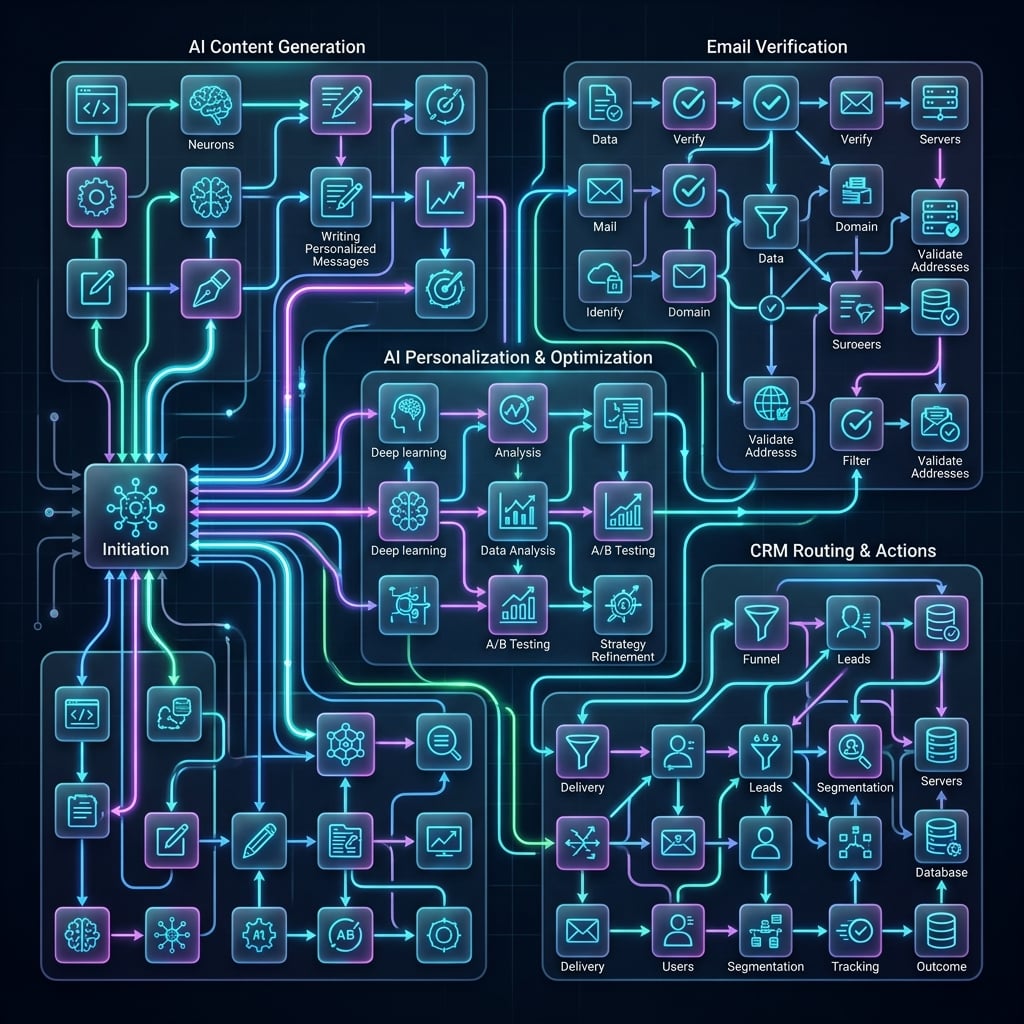
The Full Architecture — Apollo.io + n8n Cold Outreach Machine
 Click to expand
Here is the complete pipeline. This is what I build for agency clients who want outbound running without a human touching it.
Pipeline Overview
ICP Definition (Form Input)
        ↓
Apollo.io API — Prospect Sourcing
        ↓
n8n — Data Processing & Routing
        ↓
Email Verification (ZeroBounce API)
        ↓
OpenAI — AI Personalisation Layer
        ↓
LinkedIn Invite (optional) via Unipile
        ↓
Instantly / Brevo — Sequence Delivery
        ↓
Reply Monitoring → n8n → CRM Update
Stage 1: ICP Definition and Apollo Prospecting
You start with a Webhook or Form Trigger in n8n where you input your targeting criteria: job titles, company size range, industry, geography, funding stage, tech stack. n8n passes these parameters to an OpenAI node which constructs a precise Apollo.io search URL from natural language inputs (this is cleaner than manually building Apollo URL parameters every time you run a new campaign).
The constructed URL goes to the Apollo.io API via an HTTP Request node. Apollo returns a paginated list of matching contacts — name, title, company, email, LinkedIn URL, company revenue, employee count, and any intent signals they've tagged.
n8n paginates through the results, normalising and deduplicating records, then writes them to a Google Sheets staging table or directly to Airtable if you prefer a visual base to review before sending.
API note: If you're on the Organization plan with full API access, you call Apollo's People Search and People Enrich endpoints directly. If you're on Basic or Professional with limited API calls, use an Apify Apollo Scraper actor instead — it wraps the Apollo interface without consuming your API quota and returns the same structured data. This is a legitimate, commonly-used workaround in the n8n + Apollo community.
Stage 2: Email Verification
Before a single email is sent, every contact passes through an email verification node. This is non-negotiable.
The n8n HTTP Request node calls the ZeroBounce API for each email. ZeroBounce returns a status: valid, invalid, catch-all, unknown, or spamtrap. The n8n Switch node routes:
valid→ proceed to personalisationcatch-all→ flag for manual review (send cautiously)invalid/spamtrap→ immediately discard
This single step keeps your sender domain bounce rate under 2%, protecting your email infrastructure from the 15–25% Apollo raw data bounce rate that destroys sender reputation without verification.
Stage 3: AI Personalisation — The Step That 10x's Reply Rates
Generic cold email is dead. What actually gets replies in 2026 is a first line that proves you researched the person — something referencing their recent LinkedIn post, a company announcement, a funding round, or a role change.
In n8n, for each verified contact, an HTTP Request node calls the OpenAI API (GPT-4o) with a structured prompt:
You are a B2B outreach copywriter. Write a cold email first line (max 2 sentences)
for [FIRST NAME] at [COMPANY NAME].

Context:
- Their job title: [TITLE]
- Recent LinkedIn activity: [SCRAPED LINKEDIN POST OR ACTIVITY]
- Company recent news: [COMPANY NEWS FROM TAVILY SEARCH]
- Company tech stack: [TECH STACK]

The first line should feel genuinely researched, reference something specific,
and connect naturally to: [YOUR VALUE PROPOSITION].

Output JSON only: { "first_line": "..." }
For the LinkedIn activity and company news context, add a Tavily Search node before the OpenAI call — Tavily is a real-time search API designed specifically for AI agents. It returns recent web results about the company or person, which the OpenAI node then uses to write a first line that feels human and researched.
The result: every contact in your list gets a unique, contextually relevant opening line — at scale, in seconds, for fractions of a cent per email.
Stage 4: LinkedIn Connection (Optional but Powerful)
Before the email lands, a LinkedIn connection request warms the prospect. When they see your email two days later, they recognise your name from the pending LinkedIn notification. Reply rates on combined LinkedIn + email sequences are 2–3x higher than email alone.
In n8n, the Unipile node (or HTTP Request to Unipile's API) handles LinkedIn automation — sending a personalised connection request with a short note, logging the request status back to your Google Sheet or Airtable.
One guardrail: LinkedIn's API is strict. Limit automated connection requests to 20–30 per day per account to stay within safe thresholds. n8n's Wait node (set to random interval between 3–8 minutes) adds natural spacing between requests to avoid triggering LinkedIn's automation detection.
Stage 5: Sequence Delivery via Instantly or Brevo
Once the contact is verified, personalised, and has received a LinkedIn invite (if applicable), the outreach sequence fires.
If using Instantly: n8n calls the Instantly API to add the contact to a pre-built campaign with their personalised first line injected as a custom variable. Instantly handles inbox rotation, warmup, and send-time optimisation automatically.
If using Brevo: n8n calls the Brevo API to create or update the contact, tag them with their lead source and intent score, enroll them in the relevant automation workflow, and trigger the first email. Brevo handles multi-step sequences, follow-up scheduling, and reply detection natively. This approach keeps everything in one system if you're already using Brevo for email marketing — one dashboard for both cold outreach and warm nurture.
A typical 3-step sequence looks like:
- Day 1 — First touch: personalised opening line + value proposition + single CTA (book a call, reply to this email)
- Day 4 — Follow-up 1: brief, no re-pitch. Reference the first email, add a different proof point or case study
- Day 10 — Follow-up 2: the "breakup" email — short, direct, closes the loop. Often gets the highest reply rate of the three
Stage 6: Reply Monitoring and CRM Update
This is where most DIY outreach pipelines break. They send well, but have no system to handle replies — hot leads sit in an inbox and go cold.
The final n8n workflow runs on a schedule trigger every 15–30 minutes, checking your Gmail or Outlook inbox via the Gmail node for replies from contacts in your active campaign. When it finds a reply:
interested, not now, unsubscribe, out of office, not the right personinterested→ fires a Slack notification to the sales team with the full reply context and a one-click "book call" link, marks the contact asHot Leadin your CRM, pauses further automated sequencesnot now→ moves contact to a 90-day follow-up drip in Brevounsubscribe→ immediately marks contact as suppressed across all systems (legally required)not the right person→ prompts n8n to enrich for the correct contact at that company via Apollo
The result: no lead falls through the cracks, and your sales team only gets involved when a human has already expressed interest — their time is spent closing, not prospecting.
Real Cost Comparison — DIY Stack vs Hiring an SDR
Let's run the honest numbers.
| Component | Monthly Cost |
|---|---|
| Apollo.io Professional (1 seat) | $79 |
| ZeroBounce verification (5,000 emails) | $16 |
| Instantly Hypergrowth (unlimited inboxes) | $97 |
| OpenAI API (GPT-4o, ~10,000 emails/month) | ~$30 |
| Tavily Search API | ~$10 |
| n8n (self-hosted on a $6/mo VPS) | $6 |
| Total | ~$238/month |
Compare that to a junior SDR: $4,000–$6,000/month salary, benefits, management overhead, ramp time, and the human inconsistency of good and bad weeks. The n8n pipeline runs at the same quality at 3 a.m. on a Sunday as it does Monday morning.
At 10,000 emails per month, your cost per email is $0.024. A human SDR writing personalised emails manually costs roughly $3–$8 per email when you factor in fully loaded cost and output rate.
Where This Architecture Has Limits
Honest assessment, because you need to know this before building:
Apollo data accuracy outside the US is weaker. If your ICP is in Southeast Asia, the Middle East, or parts of Europe, email match rates drop significantly. Supplement with LinkedIn Sales Navigator for non-US prospecting.
The LinkedIn automation layer requires caution. Unipile and similar tools operate in a grey zone. LinkedIn has cracked down on automation tools periodically. Keep volumes conservative (under 30 connections/day) and always personalise the connection note — accounts sending identical connection requests at volume get flagged.
AI personalisation needs a human quality check for high-value accounts. For enterprise prospects where one deal is worth $50,000+, add a Telegram approval step in n8n before the email sends — the workflow pauses and sends you the draft to approve with a single click. This adds 30 seconds of your time per high-value email and prevents AI errors from reaching your most important prospects.
Brevo vs Instantly for cold outreach: Brevo is better for warm nurture (opted-in contacts, marketing sequences). Instantly is built specifically for cold outreach deliverability — inbox rotation, warmup, and spam monitoring are its core product. If your primary use case is cold outreach at volume, Instantly or a dedicated cold email sender is the right tool; use Brevo for the warm follow-up sequences after a prospect has engaged.
Apollo.io Alternatives — When to Use Something Else
| Alternative | Best For | Trade-off vs Apollo |
|---|---|---|
| Clay | Agencies serious about data quality and AI personalisation depth. Teams with a RevOps function. | No built-in database or sender. Higher learning curve. Need Instantly + a data source separately. |
| Instantly | Pure cold email delivery at scale. | Zero prospect data. Requires Apollo or Clay to source leads first. |
| AiSDR | AI-managed SDR workflows with less setup overhead. | Higher cost. Less control over the workflow logic. |
| LinkedIn Sales Navigator | Non-US ICPs, enterprise prospecting where LinkedIn data is more accurate than Apollo's database. | Email data requires enrichment layer. No built-in sender. |
| UpLead | Cleaner data with a 95% accuracy guarantee and bounce refund policy. | Smaller database than Apollo. No built-in sequencer. |
Who This Stack Is Right For
Build this if:
- You or your agency runs outbound for B2B clients and want to replace or scale beyond a manual SDR workflow
- Your ICP is primarily US/UK/Canada-based (where Apollo's data is strongest)
- You have basic n8n familiarity or are willing to invest a weekend learning it (the ROI is immediate)
- You want full data ownership and control over the logic — no black-box automation platform making decisions you can't see
Don't build this if:
- Your outbound volume is under 500 emails/month — at that scale, Apollo's native sequencer is sufficient without n8n complexity
- You need GDPR-verified European mobile data — supplement with Cognism or Lusha for EU compliance
- You want a no-touch, fully managed outbound service — look at AiSDR or Coldreach, which handle strategy and execution for you (at a significant cost premium)
Frequently Asked Questions
Can n8n connect to Apollo.io directly? Yes. Apollo.io has a REST API that n8n connects to via the HTTP Request node. You authenticate with your Apollo API key (found in Settings → Integrations → API). Full API access requires the Organization plan; Basic and Professional plans have throttled API call limits. For workarounds on lower plans, the Apify Apollo Scraper actor is the community-standard approach.
Does this violate Apollo's terms of service? Using Apollo's API for internal business use to automate your own outreach pipeline is explicitly permitted under Apollo's standard terms. What is not permitted is using Apollo data to power external products, resell data to clients, or share data outside your organization. Building your own agency's outbound pipeline falls squarely within permitted use.
What is the best email verification tool to pair with Apollo in n8n? ZeroBounce and NeverBounce are the two most commonly integrated tools. Both have REST APIs that plug into n8n's HTTP Request node cleanly. ZeroBounce has a slight edge for bulk verification speed; NeverBounce offers a pay-per-verification model that's more cost-effective at low volumes.
How is this different from just using Apollo's built-in sequences? Apollo's native sequencer is solid for simple email-only outreach. The n8n architecture adds: AI-powered first-line personalisation using live research (not just merge tags), email verification before sending, LinkedIn connection sequencing, CRM sync with intent classification, and reply routing logic — none of which Apollo handles natively. The n8n layer is what takes a decent outreach tool and makes it a revenue machine.
Can I use Brevo instead of Instantly for the sending layer? Yes, with caveats. Brevo is excellent for warm sequences to contacts who've already opted in or engaged. For cold outreach to contacts who have never interacted with you, Instantly's dedicated cold email infrastructure (inbox rotation, warmup, spam monitoring) is better suited. Many agencies use both: Instantly for the cold sequence, Brevo for the warm nurture sequence that kicks in after a prospect replies positively.
What's the minimum Apollo plan to run this n8n pipeline? You can start on Basic ($49/mo) using the Apify Apollo Scraper workaround for data extraction. For direct API access with higher throughput, Organization ($119/mo, min. 3 seats) is required. For most solo agency operators, Basic + Apify is the right starting point.
What to Build Next
This pipeline handles outbound prospecting. The natural next step is closing the loop: once a lead replies and books a call, what happens?
The answer is a CRM enrichment and deal management workflow — automatically creating a deal in HubSpot or monday.com, pulling the company's LinkedIn data, scheduling a pre-call research brief, and logging all touchpoints in one place. That's the full RevOps architecture, and it's the next teardown in this series.
Alfaz Mahmud Rizve is a RevOps architect and automation engineer who builds autonomous outbound and revenue systems for scaling agencies. He specialises in n8n workflow architecture, AI agent deployments, and multi-tool GTM stack design. Book a strategy call or request a free RevOps audit to map your agency's outbound architecture.
Related reads:
- ManyChat Pricing 2026: Is It Still Worth It for Agencies?
- Build an n8n AI Receptionist That Answers Calls 24/7
- Automated Email Follow-Up with n8n + Brevo: The Smart Agency Stack
Core Deployment Stack
To build this exact architecture in production, you will need the core infrastructure. I strictly use and recommend the following enterprise-grade platforms.
Apollo.io
The ultimate B2B database and sales engagement platform for lead generation.
n8n Cloud
The most powerful fair-code automation platform. Get 20% off your first year on any paid plan.
Brevo (formerly Sendinblue)
Enterprise-grade email API and marketing automation. Excellent SMTP for n8n.
Complementary RevOps Toolchain
Vultr High-Performance Cloud
Deploy self-hosted vector databases & AI infrastructure worldwide. Get $300 in free credit.
Pinecone Vector Database
The vector database for building AI applications. Essential for RAG architectures.
Qdrant Cloud
Rust-native vector search engine for the next generation of AI. Fast, scalable, and memory-efficient.
Ready to automate your agency?
Skip the manual grunt work. Let's build a custom system that runs your business on autopilot 24/7.